
research
An overview of some of my ongoing and published research
projects.
For a full list of published works,
see my CV.
journal articles
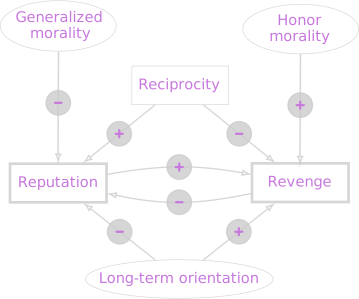
Why do people in some societies take revenge when they are cheated, while in others they respond by gossiping or simply by cutting ties with the offender? Via a game-theoretical model, the paper argues that a plausible explanation for these differences are cultural beliefs. Extensive empirical tests, drawing on ethnographic data from pre-industrial societies and from four modern cross-national survey programs, suggest that the proposed framework captures general mechanisms underlying cross-cultural variation in enforcement strategies.
Link to replication materials: OSF
Working papers
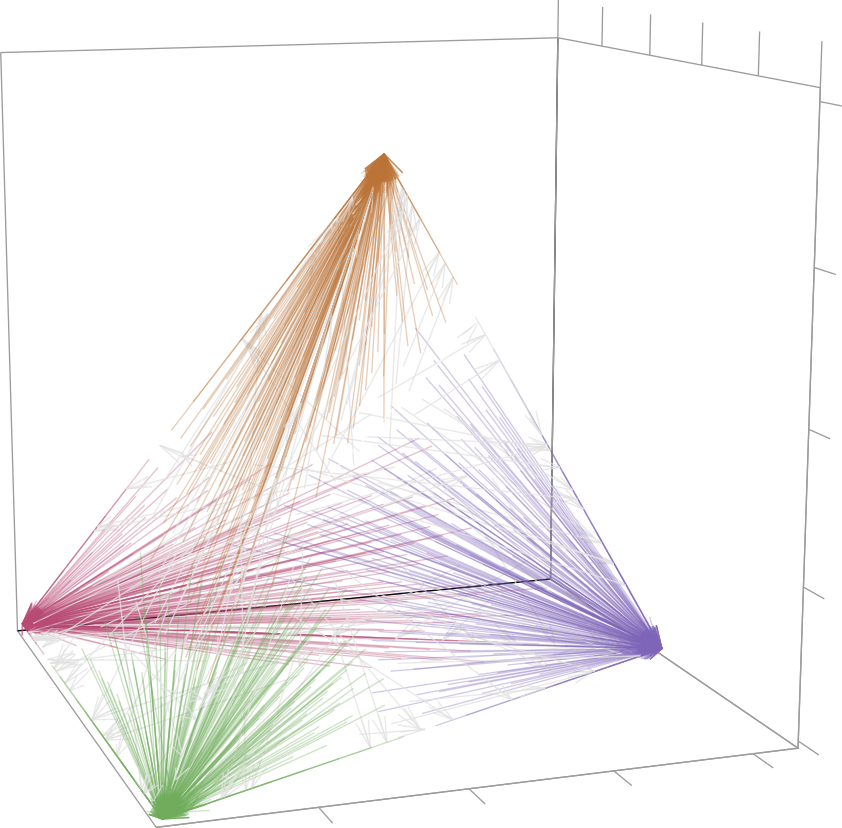
Why do moral beliefs change over time? And which factors cause change, stability and direction of these dynamics? Using an analytically grounded agent-based simulation, the paper models how different moral configurations — honor-based, dignity-based, parochial, and universal — compete and evolve. Beyond identifying materially favorable environments for the proliferation of each belief system, one key result is a cyclical, rock–paper–scissors-like dynamic among them: moral systems can successively outcompete one another, producing systematic temporary phenomena such as resurgent honor spikes during broader cultural transitions.
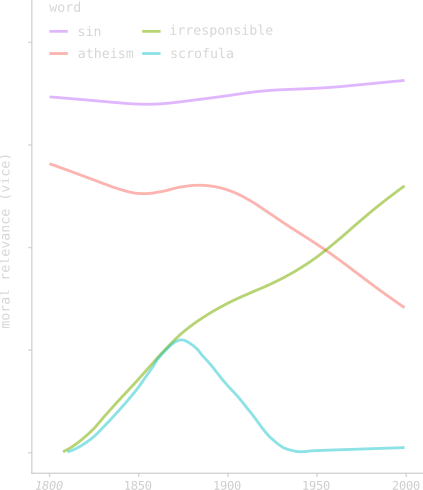
Because cultural change unfolds over decades and centuries, reliable and comparable historical data is paramount to research on cultural dynamics. In many cases, the only existing source of this data is textual artifacts. However, standard natural language processing tools cannot account for the fact that language itself evolves. The paper lays out a computationally efficient, context-sensitive approach that tracks the shifting meanings of semantic expressions through embedding based anchoring. Several validation experiments, using the Moral Foundations Theory as a test case, show that the method outperforms static dictionaries and out-of-the-box transformer models in tracing moral dynamics in multiple long-run corpora.
work in progress
Moral universalism captures how far our sense of “right” and “wrong” extends — whether it applies only to close others or also to strangers. This cultural dimension has been linked to a wide range of outcomes central to the social sciences, from cooperation and trust to economic development and political preferences. Yet, we know little about how it evolves over the long run, largely because historical cultural data are scarce. To fill this gap, the project exploits regional historical newspapers records from the Chronicling America database, linked to U.S. census records, to trace universalist dynamics and their historical correlates.